
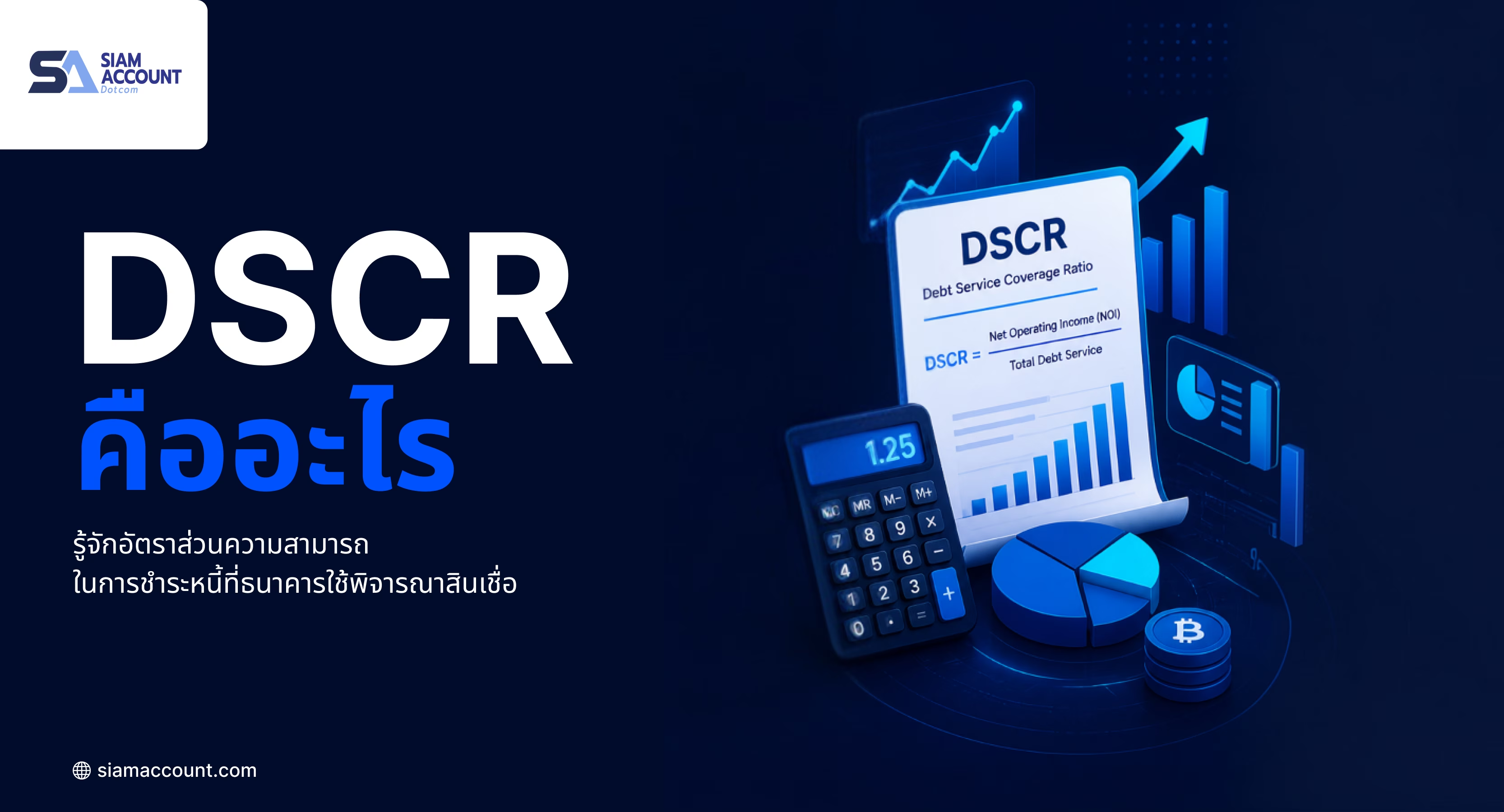
"The books show a profit — so why did the bank turn us down?" It is the question SME and startup owners ask most often after a loan application fails. The reason is usually not that you are unprofitable. It is a number called DSCR: your debt service coverage ratio has fallen below the bank's threshold.
In this article SiamAccount explains what DSCR is, how it relates to EBITDA, and how an owner can manage the number so the bank wants to approve the facility.
What is DSCR (Debt Service Coverage Ratio)?
In short: DSCR stands for Debt Service Coverage Ratio. It is the measure a bank uses to judge whether the cash your business generates from operations is enough to repay the principal and interest falling due each year.
In an owner's language, DSCR answers this: for every baht the business brings in, how much has to go straight back out to service debt, and how much actually stays? Banks do not look at net profit alone, because net profit is reduced by accounting charges that never left the bank account — depreciation being the obvious one. DSCR is how they see the cash genuinely available to service debt.
How to calculate DSCR (with a worked example)
In short: divide EBITDA (earnings before interest, tax, depreciation and amortisation) by the total debt falling due that year (principal plus interest). A result above 1.25 is considered safe.
The formula: DSCR = EBITDA / debt due within 12 months (principal + interest)
Here is how it plays out across two companies with identical earnings but different debt loads:
| Financial data (per year) | Company A (over-leveraged) | Company B (balanced) |
|---|---|---|
| 1. EBITDA (cash generated) | THB 3,000,000 | THB 3,000,000 |
| 2. Existing loan repayments (principal + interest) | THB 1,500,000 | THB 800,000 |
| 3. Repayments on the new facility being requested | THB 1,800,000 | THB 1,200,000 |
| Total annual debt service (2 + 3) | THB 3,300,000 | THB 2,000,000 |
| DSCR (line 1 ÷ total debt service) | 0.90× ❌ (declined) | 1.50× ✅ (approved) |
What DSCR do Thai banks require?
In short: Thai banks generally want DSCR above 1.25×, and some ask for 1.5× where the sector is considered higher risk. Below 1.0× means the business does not generate enough cash to service its debt, and the application will be declined.
You can read the financial health of a business straight off the ratio:
- Below 1.0 (danger zone): The business earns THB 100 and owes THB 110. It is living off reserves or refinancing old debt with new. No bank will approve this.
- 1.0 – 1.20 (high risk): Cash in exactly covers debt out, with no cushion. One bad quarter and liquidity disappears.
- Above 1.25 (safe zone): THB 125 earned against THB 100 of debt service, leaving THB 25 for growth or working capital. This is the range banks like.
Checklist: raising DSCR before you apply
In short: if your DSCR is too low there are only two levers — raise the numerator (EBITDA) by cutting costs or growing revenue, or lower the denominator (debt service) by refinancing over a longer term or clearing small facilities before applying.
As CFO advisors we usually ask owners to start this at least six months before approaching a bank:
Case study: getting a Chiang Mai car rental business approved
In short: a car rental company wanted to expand its fleet but was declined at a DSCR of 1.05. We rebuilt the accounting, refinanced the older vehicles, and produced a fresh cash flow projection — lifting DSCR to 1.45 and securing full approval.
Success Story
Removing an accounting constraint to unlock fleet expansion
A Chiang Mai car rental and platform business was fully booked through high season and wanted THB 10 million to buy more vehicles. The bank declined: the existing accounts recorded every vehicle lease as short-term, which inflated annual outgoings and pushed DSCR down to 1.05.
Our corporate accounting team restructured the financing. We negotiated a sale and leaseback to convert short-term debt into long-term debt and reduce the monthly instalment, then used cloud accounting to pull profit-per-vehicle data into a proper cash flow projection. DSCR rose to 1.45 and the facility was approved in full.
⚠️ Do not dress up the accounts to mislead a bank
Falsifying financial statements or concealing liabilities is a criminal offence and permanently damages the company's credit standing. A legitimate improvement in DSCR comes from debt restructuring and from reporting real revenue under proper accounting standards — nothing else.
Frequently asked questions about DSCR
Q1: Construction firms often fall below the DSCR threshold. What can be done?
▼
Construction businesses recognise revenue unevenly, so cash flow swings hard. The fix is to have the accounting team project revenue on a percentage-of-completion basis and present signed contracts (the backlog) so the bank can see the future revenue is already secured.
Q2: For a business asset purchase, is DSCR assessed personally or at company level?
▼
If you borrow as a company, the bank assesses the company's DSCR. For smaller SMEs, however, banks usually also review the personal debt service ratio of the signing director in order to judge the overall risk.
Q3: Low season pushes our hotel's EBITDA down. Can we still get approved?
▼
Yes. For hotels and accommodation, banks annualise revenue rather than judging a single month. What matters is reporting that clearly shows high season profit offsetting the low season dip.
Summary: let a CFO advisor prepare your DSCR
In short: DSCR is not just a number to satisfy a bank. It is the buffer that stops debt from tipping your business over. Good loan-ready financials are not built in the month before you apply — they are planned a year ahead.
If you run a business in Chiang Mai, Lamphun or Lampang and you are planning to borrow to expand, but you are not confident the numbers will clear the bank's threshold, we can look at them with you.
Let SiamAccount get your financials loan-ready
Stop worrying about a declined application. Our loan advisory and CFO service reviews your accounting structure, calculates DSCR, and builds the financial projections a bank expects to see.